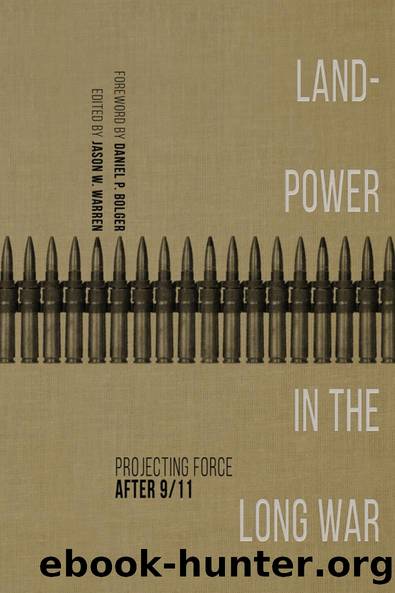
Landpower in the Long War by Jason W. Warren
Author:Jason W. Warren [Warren, Jason W.]
Language: eng
Format: epub
Tags: Nonfiction, Social & Cultural Studies, Political Science, International, International Security, History, Military, Other
ISBN: 9780813177601
Publisher: The University Press of Kentucky
Published: 2019-06-14T04:00:00+00:00
The Cold War
The last point referenced by the 9/11 Commission above, the âsharing of information,â remains vital, especially between the CIA and the Army. The uneasy relationship between the two began with the formerâs inception from the 1947 National Security Act. The CIA received its own personnel, budget, and mandate to gather and produce independent intelligence, which curtailed the role of the Armyâs director of intelligence in influencing national intelligence decisions. In addition, the CIA now oversaw a great deal of economic and political intelligence that was within the Armyâs former sphere.21
CIA-Army tension and politicization reached its Cold War apex during the Vietnam War. While there were several issues between the CIA and the Army, the most infamous incident occurred from the fallout of the 1968 Tet Offensive over the Order of Battle (OB) of enemy troop strength. CIA analyst Sam Adams was at the center of the OB controversy. Late in 1965, Adams began studying the troop strength of the Viet Cong and the North Vietnamese Army. He worked alone and received little support or encouragement on his OB assignment. He concluded that total enemy strength was close to 600,000 and should include irregulars (guerrillas), rather than the 280,000 figure cited by General William Westmorelandâs Military Assistance Command, Vietnam (MACV).22 When reflecting on his tenure as MACV commander, Westmoreland discounted Adamsâs claims that MACV ignored his estimates and underrated enemy strength. Westmoreland stated, âThe problem might have been handled by other than a unified command had each of the intelligence agencies been assigned as a âlead agencyâ on some particular aspect of intelligence.â For Westmoreland, too many agencies contested with each other and âwhen something is everybodyâs business, it is nobodyâs business.â23
The OB was significant to Westmoreland if it illustrated that progress was being made in his quest to reach his âcross-overâ point, which indicated the enemy could not replace its troops lost to attrition. The estimates of OB were the responsibility of MACV J-2 (joint staff intelligence), and they kept these estimates low in order to demonstrate American success, per the order of Westmoreland.24 Veteran senior CIA officer Harold P. Ford explains, âIn 1967â1968 ⦠available evidence convinced virtually all CIA officers that the enemy had additional tens of thousands of irregular troops that were militarily significant, but which MACV would not count.â25 MACV would not change its troop strength estimates despite new recommendations, and the CIA ultimately gave in to Westmoreland and MACVâs demands. DCI Richard Helms accepted this and acknowledged in his memoir a âsignificant political problem ⦠in view of the continuing increase in U.S. personnel and armaments in South Vietnam, any admission that the Viet Cong were actually gaining strength would obviously have stirred public reaction on the home front.â26
Westmoreland and his staff felt obliged to show progress. They would not admit enemy strength was greater than their own estimates. Returning from his visit to the troops at Cam Ranh Bay in South Vietnam, President Lyndon B. Johnson, at a meeting with General Earle Wheeler, noted, âI like Westmoreland ⦠Westmoreland has played on the team to help me.
Download
This site does not store any files on its server. We only index and link to content provided by other sites. Please contact the content providers to delete copyright contents if any and email us, we'll remove relevant links or contents immediately.
| Anthropology | Archaeology |
| Philosophy | Politics & Government |
| Social Sciences | Sociology |
| Women's Studies |
The Secret History by Donna Tartt(19088)
The Social Justice Warrior Handbook by Lisa De Pasquale(12190)
Thirteen Reasons Why by Jay Asher(8909)
This Is How You Lose Her by Junot Diaz(6887)
Weapons of Math Destruction by Cathy O'Neil(6279)
Zero to One by Peter Thiel(5802)
Beartown by Fredrik Backman(5754)
The Myth of the Strong Leader by Archie Brown(5507)
The Fire Next Time by James Baldwin(5444)
How Democracies Die by Steven Levitsky & Daniel Ziblatt(5218)
Promise Me, Dad by Joe Biden(5153)
Stone's Rules by Roger Stone(5088)
A Higher Loyalty: Truth, Lies, and Leadership by James Comey(4963)
100 Deadly Skills by Clint Emerson(4925)
Rise and Kill First by Ronen Bergman(4789)
Secrecy World by Jake Bernstein(4753)
The David Icke Guide to the Global Conspiracy (and how to end it) by David Icke(4718)
The Farm by Tom Rob Smith(4509)
The Doomsday Machine by Daniel Ellsberg(4490)
